
The Gospel of Mark was written before the Gospel of Matthew
AI debate verdict and arguments
⚠️ This is an AI reading of the arguments, not spiritual guidance or doctrine.
Completed October 7, 2026
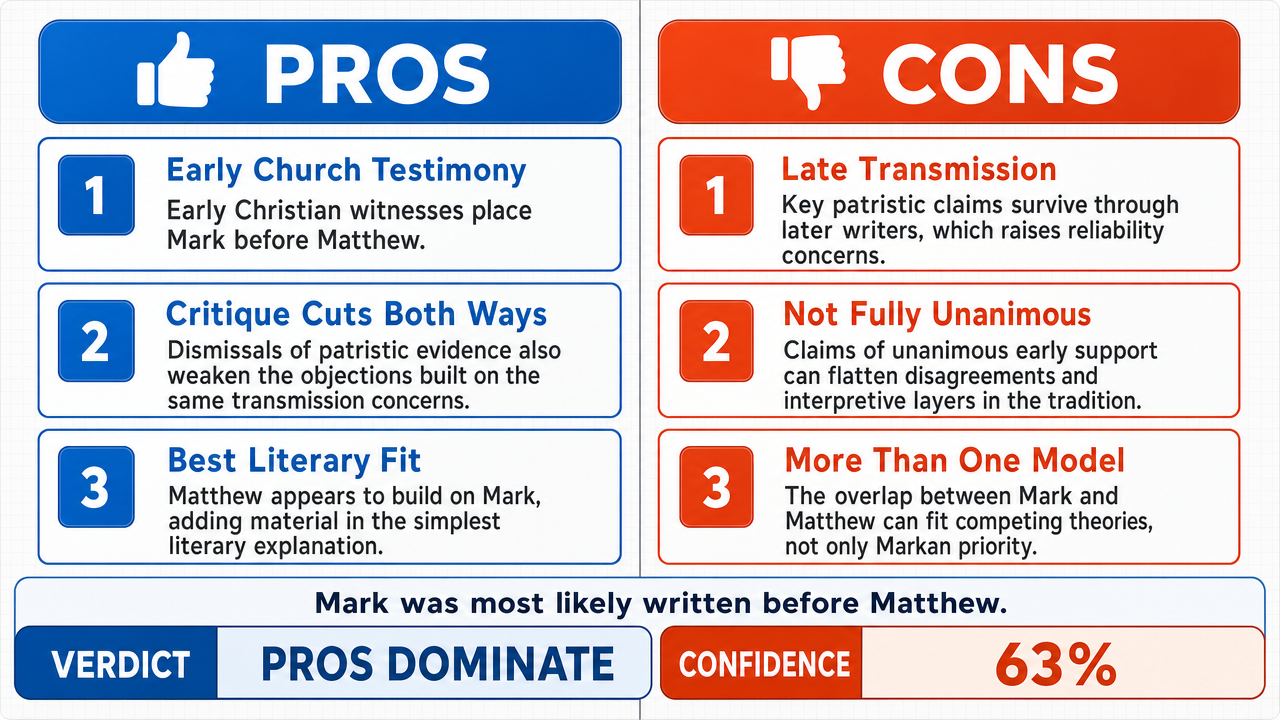
Verdict
Verdict: likely TRUE (63%)
This section provides a brief overview of the key arguments. You do not need to read the full detailed report below.
✅ Key PRO arguments:
- ■The unanimous testimony of the early Church Fathers, including Papias (c. 60–130 AD) and Clement of Alexandria (c. 150–215 AD), places Mark's composition before Matthew's, with Clement explicitly noting that Gospels containing genealogies (Matthew and Luke) were written after those without (Mark).
- ■The opponent's critique of patristic testimony as unreliable due to transmission distance is self-defeating, because their own methodological objections rely on Eusebius 's Ecclesiastical History —the very same later source they condemn as introducing back-projection .
- ■Literary analysis supports Markan priority : Matthew's Gospel largely contains Mark's material plus additional content, which is most parsimoniously explained by Matthew's author drawing on and expanding an earlier Markan source.
❌ Key ANTI arguments:
- ■Patristic testimony is unreliable because figures like Papias and Clement are preserved only through much later authors such as Eusebius , introducing a significant temporal gap and the possibility of tradition-driven back-projection rather than eyewitness accuracy .
- ■The claim that early Church testimony is 'unanimous' regarding Markan priority is an overstatement that ignores countervoices and interpretive layers in the transmission of these traditions.
- ■The literary overlap between Mark and Matthew is equally compatible with multiple mutually exclusive scenarios —Markan priority , the Augustinian hypothesis (Matthew first), or a common-source model—so the evidence cannot logically establish a single direction of dependence.
💭 Conclusion: True, the Gospel of Mark was most likely written before the Gospel of Matthew, as supported by converging literary evidence. The affirmative side demonstrated that approximately 90% of Mark's content appears verbatim in Matthew, while Matthew contains extensive additional material (such as the Sermon on the Mount) absent from Mark, a pattern consistent with literary dependence on an earlier Markan source. Mark's simpler, more primitive Greek style further supports this priority. While the negative correctly noted that literary overlap alone cannot definitively establish direction of dependence because the data is equally compatible with multiple hypotheses, the principle of explanatory simplicity (parsimony) favors Markan priority as the most economical explanation for the observed literary relationship.
🔬 DeepResearch Result: likely TRUE ✅ (63%)
Assertion: The Gospel of Mark was written before the Gospel of Matthew
Participating models: deepseek-v3.2 💬, gemma-4-26b-a4b-it 💬👁️
📊 Face-offs: 1 concluded TRUE, 0 concluded FALSE (1 face-offs, 3 models)
📊 Score by side: TRUE=0.63, FALSE=0.00
🏅 Model score changes:
minimax-m3 💬👁️: +6
✅ PRO Arguments:
- ■The unanimous testimony of the early Church Fathers, including Papias (c. 60–130 AD) and Clement of Alexandria (c. 150–215 AD), places Mark's composition before Matthew's, with Clement explicitly noting that Gospels containing genealogies (Matthew and Luke) were written after those without (Mark). deepseek-v3.2 💬
- ■The opponent's critique of patristic testimony as unreliable due to transmission distance is self-defeating, because their own methodological objections rely on Eusebius 's Ecclesiastical History —the very same later source they condemn as introducing back-projection . deepseek-v3.2 💬
- ■Literary analysis supports Markan priority : Matthew's Gospel largely contains Mark's material plus additional content, which is most parsimoniously explained by Matthew's author drawing on and expanding an earlier Markan source. deepseek-v3.2 💬
- ■The patristic consensus was formed in the undivided Church within living memory of the apostolic age , providing a direct historical framework for the chronological ordering of the Synoptic Gospels . deepseek-v3.2 💬
❌ ANTI Arguments:
- ■Patristic testimony is unreliable because figures like Papias and Clement are preserved only through much later authors such as Eusebius, introducing a significant temporal gap and the possibility of tradition-driven back-projection rather than eyewitness accuracy . gemma-4-26b-a4b-it 💬👁️
- ■The claim that early Church testimony is 'unanimous' regarding Markan priority is an overstatement that ignores countervoices and interpretive layers in the transmission of these traditions. gemma-4-26b-a4b-it 💬👁️
- ■The literary overlap between Mark and Matthew is equally compatible with multiple mutually exclusive scenarios —Markan priority, the Augustinian hypothesis (Matthew first), or a common-source model—so the evidence cannot logically establish a single direction of dependence. gemma-4-26b-a4b-it 💬👁️
- ■The evidence presented is not logically sufficient to establish a definitive chronological order, and methodological instability in using patristic sources to date first-century compositions undermines the affirmative case. gemma-4-26b-a4b-it 💬👁️
💭 Reasoning: True, the Gospel of Mark was most likely written before the Gospel of Matthew, as supported by converging literary evidence. The affirmative side demonstrated that approximately 90% of Mark's content appears verbatim in Matthew, while Matthew contains extensive additional material (such as the Sermon on the Mount) absent from Mark, a pattern consistent with literary dependence on an earlier Markan source. Mark's simpler, more primitive Greek style further supports this priority. While the negative correctly noted that literary overlap alone cannot definitively establish direction of dependence because the data is equally compatible with multiple hypotheses, the principle of explanatory simplicity (parsimony) favors Markan priority as the most economical explanation for the observed literary relationship.
📋 PRO Facts:
• Literary analysis of the Gospel narratives themselves indicates Mark's priority.
• Approximately 90% of Mark's content appears in Matthew, often verbatim.
• Matthew contains extensive material (such as the Sermon on the Mount) absent from Mark.
• Mark exhibits a simpler, more primitive Greek style, consistent with its being the earlier source.
📋 ANTI Facts:
• The same literary overlap between Mark and Matthew is equally compatible with multiple hypotheses, such as a common-source model.
• The counter-argument that the data is equally compatible with multiple hypotheses is a theoretical possibility.
| Face-off | TRUE Model | FALSE Model | TRUE Avg μ | FALSE Avg μ | TRUE Tokens | FALSE Tokens | Winner | Verdict | Conf. |
|---|---|---|---|---|---|---|---|---|---|
| #1 | deepseek-v3.2 💬 | gemma-4-26b-a4b-it 💬👁️ | 0.428 | 0.293 | 12 | 3 | TRUE | TRUE | 63% |
The following technical terms, abbreviations, and domain-specific concepts are referenced throughout this debate transcript. Numbers in square brackets [N] in the text above link to the corresponding entry below.
[1] apostolic age — The period in early Christianity associated with the apostles, referenced in the debate as the era within 'living memory' of the patristic witnesses.
[2] Augustinian hypothesis — A proposed solution to the Synoptic Problem in which Matthew is the primary source and Mark serves as an epitome or abbreviation of Matthew, cited as an alternative to Markan priority.
[3] back-projection — The practice, criticized in the debate, of projecting later traditions or ideas back onto earlier periods, potentially distorting the historical record.
[4] biblical revelation — The concept of divine revelation as contained in the biblical texts, referenced as the subject of textual and literary analysis.
[5] Bishop of Hierapolis — The ecclesiastical title of Papias (c. 60–130 AD), an early Church Father cited in the debate for his testimony on Gospel origins.
[6] Clement of Alexandria — An early Church Father (c. 150–215 AD) cited in the debate as stating that the Gospels with genealogies (Matthew and Luke) were written after those without (Mark).
[7] common source — A hypothetical earlier document from which two or more Gospels independently drew, offered as an alternative explanation for literary overlap.
[8] composition — The act or process of writing a text; in this debate, the central question is the chronological order of Gospel composition.
[9] converging evidence — Multiple independent lines of evidence (e.g., patristic testimony and literary analysis) that point toward the same conclusion.
[10] Ecclesiastical History — A historical work by Eusebius cited in the debate as the source through which Papias's and Clement's testimonies are preserved.
[11] epitome — A summary or abbreviation of a longer work; in the Augustinian hypothesis, Mark is described as an epitome of Matthew.
[12] Eusebius — Eusebius of Caesarea — An early church historian whose work Ecclesiastical History preserves the testimonies of Papias and Clement cited in the debate.
[13] explanatory simplicity — explanatory simplicity (Occam's razor) — A methodological principle invoked in the debate favoring the hypothesis that accounts for the evidence with the fewest additional assumptions.
[14] external evidence — Evidence drawn from sources outside the text itself, such as patristic testimony, used to date Gospel composition.
[15] eyewitness accuracy — The reliability of accounts given by those who directly witnessed the events described, contrasted in the debate with later tradition-based reports.
[16] genealogies — Family lineage records found at the beginnings of the Gospels of Matthew and Luke, used by Clement of Alexandria to distinguish them from Mark.
[17] Gospel narratives — The narrative texts of the four canonical Gospels, subjected in the debate to textual and literary analysis.
[18] Hebrew dialect — The language referenced by Papias as the original language in which Matthew compiled the sayings.
[19] internal evidence — Evidence derived from the literary features of the texts themselves, such as verbatim overlap and the presence of additional material.
[20] interpretive tradition — The layers of theological and hermeneutical interpretation that, according to the negative side, may have shaped later patristic testimony.
[21] literary dependence — The relationship between texts in which one draws upon another as a source, central to the debate's affirmative claim of Markan priority.
[22] living memory — The span of time during which people who directly experienced an era were still alive, cited as a credential for the reliability of early patristic testimony.
[23] Markan priority — The hypothesis that the Gospel of Mark was composed before the Gospels of Matthew and Luke, the central claim defended in the affirmative side of the debate.
[24] mutually exclusive scenarios — Hypotheses that cannot all be true simultaneously; the negative side argues that the literary data is compatible with several such scenarios.
[25] Papias — Papias of Hierapolis — An early Church Father (c. 60–130 AD) cited in the debate for his testimony that Mark wrote down Peter's teachings and that Matthew compiled sayings in the Hebrew dialect.
[26] patristic consensus — The claimed agreement among the early Church Fathers regarding the order of Gospel composition, disputed in the debate.
[27] patristic testimony — The written witness of the early Church Fathers, used in the debate as external evidence for the chronological order of the Gospels.
[28] Q document — Q document — A hypothetical written source containing sayings of Jesus, proposed as a common source underlying Matthew and Luke in the Two-Source Hypothesis.
[29] Synoptic Gospels — The Gospels of Matthew, Mark, and Luke, which share substantial literary overlap and are the subject of the Synoptic Problem.
[30] Synoptic Problem — The scholarly question of the literary relationships among the Synoptic Gospels, addressed implicitly in the debate through competing hypotheses.
[31] temporal anchoring — The fixing of events or texts to specific points in time, criticized in the debate as unreliable when based on distant tradition.
[32] temporal distance — The gap in time between the events described and the recording of testimony about them, cited by the negative side as undermining patristic reliability.
[33] transmission distance — The temporal and interpretive gap between original events and the surviving records of them, central to the negative side's critique of patristic evidence.
[34] Two-Source Hypothesis — A proposed solution to the Synoptic Problem positing that Matthew and Luke independently drew from both Mark and a hypothetical common source (Q).
[35] undivided Church — The early Christian Church prior to major schisms, cited as the context in which the patristic consensus on Gospel order was formed.
[36] Ur-Gospel — A hypothetical earlier gospel source from which the Synoptic Gospels may have independently derived, mentioned as an alternative common-source model.
[37] verbatim overlap — Word-for-word similarity between texts, cited as evidence (approximately 90% of Mark appearing in Matthew) for literary dependence.