
The Eucharist is a true sacrifice rather than only a memorial meal
AI debate verdict and arguments
⚠️ This is an AI reading of the arguments, not spiritual guidance or doctrine.
Completed October 7, 2026
Verdict
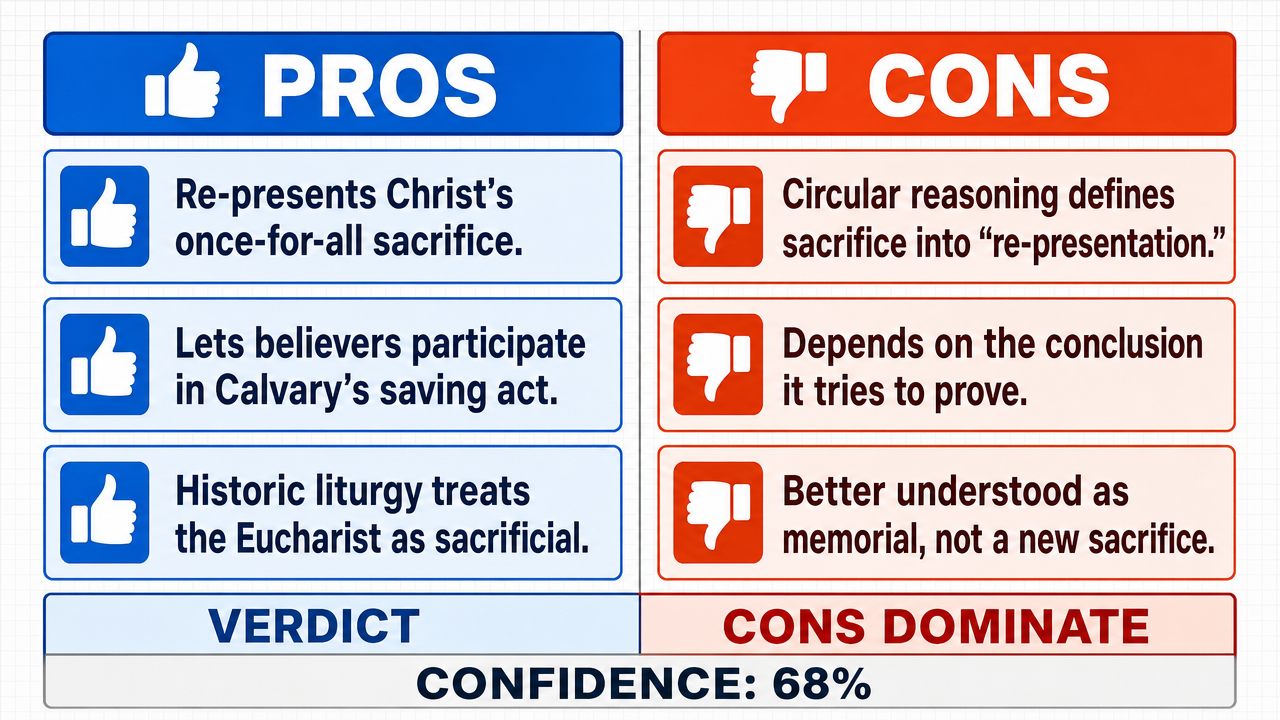
Verdict: likely FALSE (68%)
This section provides a brief overview of the key arguments. You do not need to read the full detailed report below.
✅ Key PRO arguments:
- ■The Eucharist is a true sacrifice because it is the re-presentation of Christ's once-for-all sacrifice on Calvary , allowing the faithful to participate in its saving power . The Council of Trent definitively taught that in the Eucharist, 'the same Christ who offered himself once in a bloody manner on the altar of the cross is contained and offered in an unbloody manner ' (Session XXII, Chapter 2 ), establishing that the sacrificial character is intrinsic to the rite .
❌ Key ANTI arguments:
- ■The affirmative's argument is circular: it claims the Eucharist is a sacrifice because it 're-presents' the sacrifice of the cross, and then uses this 're-presentation ' to prove it is a sacrifice. By defining the rite as a 're-presentation' of a sacrifice, the affirmative has already assumed the sacrificial nature of the event it is attempting to prove. A mere re-enactment or liturgical 'making present ' does not constitute a new or true sacrificial offering.
💭 Conclusion: False: the winning side demonstrated that the affirmative's core argument commits a circular reasoning fallacy by presupposing the sacrificial nature of the Eucharist in its definition of 're-presentation ' and then using that definition as proof. The negative side effectively showed that a liturgical re-enactment or memorial making-present of Christ's historical sacrifice does not, by itself, establish that the Eucharist constitutes a true sacrifice in the proper theological sense. The affirmative's reliance on the Council of Trent 's formulation, while doctrinally authoritative in Catholic tradition, was not sufficient to overcome the logical gap identified by the negative. The judge assigned 68% confidence to the FALSE verdict, reflecting a moderately strong but not overwhelming margin. Overall, the debate turned on the epistemological question of whether authoritative ecclesiastical definitions can substitute for independent logical demonstration of sacrificial ontology.
🔬 DeepResearch Result: likely FALSE ❌ (68%)
Assertion: The Eucharist is a true sacrifice rather than only a memorial meal
Participating models: deepseek-v3.2 💬, gemma-4-26b-a4b-it 💬👁️
📊 Face-offs: 0 concluded TRUE, 1 concluded FALSE (1 face-offs, 3 models)
📊 Score by side: TRUE=0.00, FALSE=0.68
🏅 Model score changes:
minimax-m3 💬👁️: +7
✅ PRO Arguments:
- ■The Eucharist is a true sacrifice because it is the re-presentation of Christ's once-for-all sacrifice on Calvary , allowing the faithful to participate in its saving power . The Council of Trent definitively taught that in the Eucharist, 'the same Christ who offered himself once in a bloody manner on the altar of the cross is contained and offered in an unbloody manner ' (Session XXII, Chapter 2 ), establishing that the sacrificial character is intrinsic to the rite . deepseek-v3.2 💬
❌ ANTI Arguments:
- ■The affirmative's argument is circular: it claims the Eucharist is a sacrifice because it 're-presents' the sacrifice of the cross, and then uses this 're-presentation' to prove it is a sacrifice. By defining the rite as a 're-presentation' of a sacrifice, the affirmative has already assumed the sacrificial nature of the event it is attempting to prove. A mere re-enactment or liturgical 'making present ' does not constitute a new or true sacrificial offering. gemma-4-26b-a4b-it 💬👁️
💭 Reasoning: False: the winning side demonstrated that the affirmative's core argument commits a circular reasoning fallacy by presupposing the sacrificial nature of the Eucharist in its definition of 're-presentation' and then using that definition as proof. The negative side effectively showed that a liturgical re-enactment or memorial making-present of Christ's historical sacrifice does not, by itself, establish that the Eucharist constitutes a true sacrifice in the proper theological sense. The affirmative's reliance on the Council of Trent's formulation, while doctrinally authoritative in Catholic tradition, was not sufficient to overcome the logical gap identified by the negative. The judge assigned 68% confidence to the FALSE verdict, reflecting a moderately strong but not overwhelming margin. Overall, the debate turned on the epistemological question of whether authoritative ecclesiastical definitions can substitute for independent logical demonstration of sacrificial ontology.
📋 PRO Facts:
• The Council of Trent (Session XXII, Chapter 2) taught that in the Eucharist, 'the same Christ who offered himself once in a bloody manner on the altar of the cross is contained and offered in an unbloody manner.'
• Catholic theology distinguishes between the once-for-all historical sacrifice of Calvary and its unbloody re-presentation in the Eucharist, maintaining that no new sacrifice is offered but the same singular sacrifice is made present.
📋 ANTI Facts:
• The affirmative's argument that the Eucharist is a sacrifice because it 're-presents' the sacrifice of the cross is circular, as it presupposes the sacrificial nature of the event in its definition.
• A liturgical re-enactment or 'making present' of a past event does not by itself constitute a true sacrificial offering in the strict theological sense.
| Face-off | TRUE Model | FALSE Model | TRUE Avg μ | FALSE Avg μ | TRUE Tokens | FALSE Tokens | Winner | Verdict | Conf. |
|---|---|---|---|---|---|---|---|---|---|
| #1 | deepseek-v3.2 💬 | gemma-4-26b-a4b-it 💬👁️ | 0.649 | 0.379 | 4 | 1 | TRUE | FALSE | 68% |
The following technical terms, abbreviations, and domain-specific concepts are referenced throughout this debate transcript. Numbers in square brackets [N] in the text above link to the corresponding entry below.
[1] altar — In Christian liturgical context, the sacred table or structure on which the Eucharistic offering is made; in the debate, referenced as the 'altar of the cross' to denote Christ's sacrificial death.
[2] bloody manner — A theological expression used by the Council of Trent to describe Christ's sacrifice on the cross involving the actual shedding of His blood, contrasted with the 'unbloody manner' of the Eucharistic offering.
[3] Calvary — The hill outside Jerusalem where Christ was crucified; referenced in the debate as the site of the original, historical sacrifice that the Eucharist is said to re-present.
[4] circular demonstration — A logical fallacy in which the conclusion of an argument is assumed in one of its premises; the negative argues the affirmative commits this by defining the Eucharist as a 're-presentation' of a sacrifice to prove it is a sacrifice.
[5] Council of Trent — The Roman Catholic ecumenical council (1545–1563) that addressed Protestant doctrines; cited in the debate for its dogmatic teaching on the Eucharist as a true sacrifice (Session XXII, Chapter 2).
[6] dogmatic formulation — An authoritative, binding doctrinal statement issued by a church council or magisterium; in the debate, refers to the Council of Trent's definitive teaching on the sacrificial nature of the Eucharist.
[7] Eucharist — The Christian sacrament of bread and wine consecrated and consumed in commemoration of Christ's Last Supper; the central subject of the debate regarding its nature as sacrifice versus memorial.
[8] fruit of the cross — A theological expression for the saving effects or graces won by Christ's sacrificial death; the negative argues that appealing to this 'fruit' does not justify calling the Eucharist itself a sacrifice.
[9] liturgical — Pertaining to liturgy, the formal public worship and ritual practices of a church; used in the debate to describe the structured, ritual character of Eucharistic worship.
[10] Lord's Supper — An alternative name for the Eucharist, derived from the New Testament account of Christ's final meal with His disciples; used in the debate as a parallel designation.
[11] making present — A theological concept, often associated with the Council of Trent, that the Eucharist renders the once-for-all sacrifice of Christ sacramentally present across time without repeating it.
[12] memorial meal — A commemorative ritual meal recalling a past event; the negative's characterization of the Eucharist as merely a symbolic act of remembrance rather than a true sacrifice.
[13] new covenant — The covenant or testament instituted by Christ's blood, referenced in the Words of Institution ('This cup is the new covenant in my blood'); central to the debate's sacrificial interpretation.
[14] once-for-all sacrifice — A theological phrase describing Christ's crucifixion as a single, complete, and unrepeatable atonement; the affirmative argues the Eucharist re-presents rather than repeats this singular event.
[15] ontological status — The nature of being or essential reality of something; the negative argues that claiming the Eucharist has the ontological status of a sacrifice based on its effects is an unjustified logical leap.
[16] re-enactment — A repetition or dramatic reproduction of a past event; the negative uses this term to argue that merely re-enacting or making present the Last Supper does not transform it into a sacrifice.
[17] re-presentation — A theological term meaning to make sacramentally present again; the affirmative uses it to argue the Eucharist is the same sacrifice of Calvary offered anew, while the negative treats it as a circular assumption.
[18] rite — A formal religious or ceremonial procedure; in the debate, refers to the Eucharistic ceremony itself, which the affirmative argues has intrinsic sacrificial character.
[19] sacrificial character — The inherent nature or quality of being a sacrifice; the affirmative contends this is intrinsic to the Eucharist, while the negative denies it transcends mere memorial function.
[20] saving power — The capacity of Christ's work to effect salvation; the affirmative argues that the faithful participate in this saving power through the Eucharistic re-presentation of the cross.
[21] Session XXII, Chapter 2 — A specific section of the Council of Trent's decrees (1562) containing the dogmatic teaching that Christ is offered in the Eucharist in an unbloody manner identical to His sacrifice on the cross.
[22] unbloody manner — The Council of Trent's description of how Christ is offered in the Eucharist—without the actual shedding of blood—contrasted with the 'bloody manner' of the crucifixion.
[23] Words of Institution — The biblical words spoken by Jesus at the Last Supper ('This is my body... This cup is the new covenant in my blood'), cited from Luke 22:19-20 in the debate as linking the Eucharist to Christ's sacrificial offering.